


Blog
Lyophilisate versus peptide solution in the laboratory

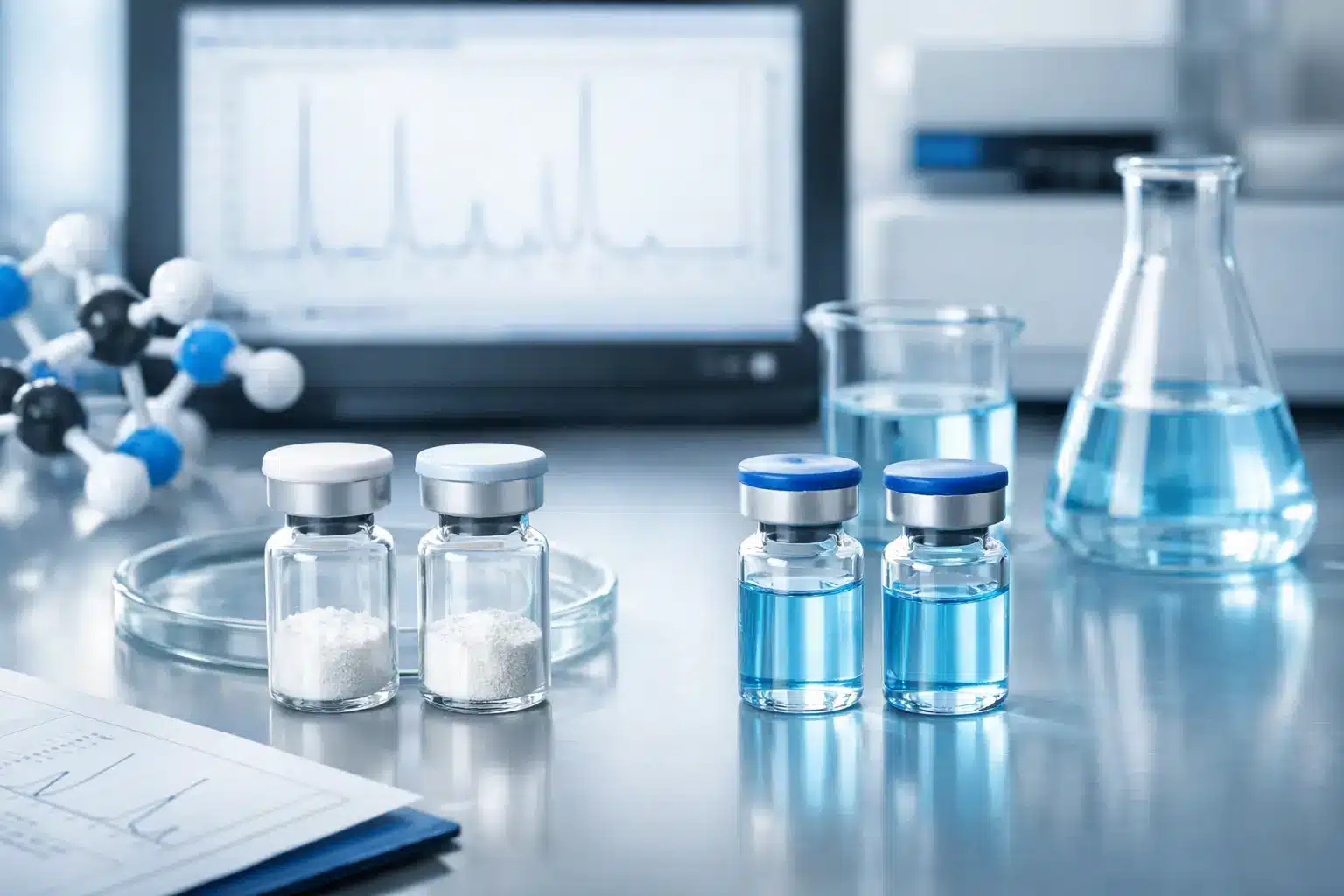
When ordering research-grade material, the peptide form is not just an item on the catalog. Lyophilisate versus peptide solution It represents a decision that can affect logistics, storage, planning of analytical measurements, and the interpretation of results. The same declared sequence and purity do not automatically mean the same practical properties of the material after delivery.
For laboratory research, it is therefore appropriate to consider the form along with the batch number, declared content, analytical purity, transport conditions, and the availability of the Certificate of Analysis (COA). The correct choice does not follow a universal rule, but rather depends on the specific analytical purpose, the time horizon, and the requirements for the material’s traceability.
Lyophilisate versus peptide solution: the fundamental difference
Lyophilizate is a material from which most of the water has been removed under controlled conditions by freezing and subsequent sublimation. The result is a solid, often porous form. In peptides, in addition to the analyte itself, it may contain residual moisture, anti-ions, salts, or other components listed in the product specification.
Peptide solution On the contrary, the material is already present in the defined solvent or buffer. Therefore, its technical characteristics do not only include the identity of the peptide and the concentration, but also the composition of the medium, pH, volume, any auxiliary substances, and the type of primary packaging.
These parameters can affect the compatibility with subsequent chromatographic, mass spectrometric or cell analytical method.
The difference between the lyophilisate and the solution is not a matter of value judgment. The lyophilized form can provide greater flexibility in planning analytical work and storage, while the ready-made solution can reduce the number of preparatory steps before measurement.
Quick comparison of lyophilized product and peptide solution
Stability is not one characteristic
The stability of peptides is often discussed in general terms, but in practice it is a set of several separate phenomena. Relevant may be the chemical stability of the sequence, the physical stability of the material, sensitivity to moisture, temperature, and light, but also the risk of adsorption onto the surface of laboratory vessels.
The specific profile depends on the amino acid composition, peptide length, the presence of modifications, the pH of the medium, the concentration, and the auxiliary ingredients used.
In a lyophilizer, molecular mobility is usually limited and the absence of a large amount of free water can slow down some degradation processes. However, this does not mean that every lyophilizer is automatically stable or can be stored regardless of the conditions.
Hygroscopic materials can absorb airborne moisture, and repeated temperature fluctuations can negatively affect their properties.
In the solution, hydrolytic stability, oxidation, possible changes in pH, interactions with the primary packaging, and other factors related to the specific medium are added to the evaluation.
Some peptides can aggregate in solution, adsorb onto plastic or glass surfaces, or exhibit time-dependent changes in the chromatographic profile. Therefore, data on stability without mentioning the medium, concentration, temperature, and time interval have limited value.
What do the storage conditions in the catalog mean?
The storage data is part of the material's technical specification, not a universal guarantee. It should be interpreted together with the information whether it applies to an unopened product, short-term working storage, or longer-term storage.
In the case of solutions, it is also advisable to distinguish between the conditions of transport and the conditions of storage after receipt.
Transparent catalog it provides the form, quantity, and storage conditions directly at the product. For more sensitive materials, it is beneficial to have information about the specific batch, analytical documentation, and the date of the analysis if available.
Analytical characterization and COA
The purity stated for a peptide is not an exhaustive description of its quality. HPLC can provide data on chromatographic purity under specific conditions of the method, but it may not independently confirm the molecular identity, the amount of peptide, or the nature of all minor components.
Therefore, combining several analytical data is important when evaluating research-grade material.
Certificate of Analysis (COA) should allow for clearly linking the material with a specific batch number and report the results of the relevant analytical control.
Data on: peptide can be particularly useful in the following cases:
- the identity of the material,
- the number of the production batch,
- chromatographic purity,
- mass characterization,
- the declared quantity,
- physical form,
- the date of the analysis,
- the analytical method used.
If a product contains an anti-ion or other declared ingredient, the documentation should make it possible to distinguish whether the stated amount refers to the total weight of the material or to the peptide content itself.
When using a solution, it is necessary to expand the evaluation to include the concentration and the medium used. Depending on the analytical purpose, data on pH, osmolality, UV absorbance or other parameters may also be relevant.
Comparability between batches
Two batches with the same declared chromatographic purity may not be completely identical from an analytical point of view.
The differences may be related to the profile of the secondary peaks, water content, anti-ion composition, concentration, or measurement uncertainty.
Therefore, for longer-term analytical series, it is advisable to keep a COA, record the batch number, and when changing the material, consider comparing the relevant analytical parameters.
This approach is particularly important when cell models and in the research of molecular mechanisms or cellular signaling.
If the form of the material changes, the batch or composition of the medium, the change in the experimental result may not automatically be related to the biological system being studied. It can also be an analytical or material variable that needs to be monitored retrospectively.
Practical criteria for choosing the form
Lyophilisate can be a practical option when the laboratory needs to work with its own analytically compatible medium, plans to use the material over a longer period of time, or needs greater flexibility in preparing analytical samples.
It is important that the workplace has clearly defined internal procedures for handling research materials, labeling prepared samples, and recording their origin.
The solution can be practical in analytical tasks that use a predefined medium or in workflows where the goal is to minimize some preparatory steps.
However, the compatibility of the solution composition with the planned analytical method must be verified. For example, the components of the buffer may affect retention behavior in chromatography, complicate mass spectrometry analysis, or change the conditions of a specific cell experiment.
The size of the packaging is also important in both forms. A too large packaging can increase the number of repeated manipulations with the same material, while very small packaging can be logistically inefficient.
The decision should therefore take into account the expected scope of analytical work, the stability of the specific material, storage options, and internal requirements for record-keeping.
When can a lyophilized product be more suitable?
The lyophilized form may be suitable especially in situations where the ability to select a compatible medium of your own is important for the analytical procedure, or when the material is planned to be used over a longer period of time.
The advantage may also be in simpler logistics for solid forms. However, specific storage conditions always depend on the properties of the given peptide and the documentation of the respective batch.
When can a peptic solution be more suitable?
The finished solution can be a practical option if its composition is compatible with the planned analytical method and the work procedure requires the material in a defined medium.
When evaluating such a product, it is necessary to know not only the declared amount of the peptide, but also the concentration, total volume, media composition, storage conditions, and the analytical documentation of the specific batch.
Frequent misunderstandings regarding catalog data
Labeling research-grade it expresses the determination of the material for research, analytical and laboratory purposes. However, it does not itself replace the detailed specification, analytical results, or verification of the suitability of the material for a specific method.
Likewise, high declared HPLC purity does not automatically mean that the material is suitable for every experimental system.
Another common misconception is to identify the lyophilized form with an absolutely pure peptide. The lyophilized product may contain anti-ions, residual moisture, or other declared ingredients that are relevant when interpreting the material’s weight.
When comparing products, it is therefore important to check whether the supplier provides the net quantity, peptide content, physical form, analytical method, and documentation for the specific production batch.
A reliable supplier does not present these data merely as marketing claims. He presents them in a way that allows the technical parameters to be linked to the specific batch, the COA, and the storage conditions.
Frequently asked questions
Is the lyophilized form always more stable than the peptide solution?
Not necessarily. Stability depends on the specific sequence, modifications, moisture content, temperature, packaging, and other factors. The lyophilized form may reduce the rate of certain degradation processes in some materials, but this is not a universal rule.
Is the peptide solution less quality than the lyophilized product?
No. The form itself does not determine the quality of the material. What matters are the identity, analytical characterization, concentration, stability, documentation of the specific batch, and the suitability of the medium for the planned analytical procedure.
What is important to check in a COA?
The COA should be clearly assigned to a specific production batch. Relevant data may include information on identity, chromatographic purity, quantity, form of the material, the analytical method used, and the date of the analysis.
Is HPLC purity sufficient for peptide comparison?
No. HPLC purity represents only one part of analytical characterization. When evaluating the material, it is advisable to also monitor identity, content, form, batch documentation, and other data according to the planned laboratory use.
Why is the batch number important?
The batch number allows the specific material to be linked to the corresponding analytical documentation and quality control results. It is important for traceability and comparability of results when material is procured repeatedly.
Conclusion
When deciding between lyophilisate and peptide solution There is no universally best form. The choice should be based on the specific analytical question, the planned work procedure, the stability of the material, the compatibility of the medium, and the available documentation.
The material that can clearly be traced to its identity, batch number, analytical results, form, quantity, and storage conditions has the greatest value.
The product form is therefore the beginning of the evaluation, not its end. What matters remains the quality of analytical data and the ability to link every experimental observation back to specific research-grade material.