


Blog
AOD-9604: structure of the hGH fragment and experimental research

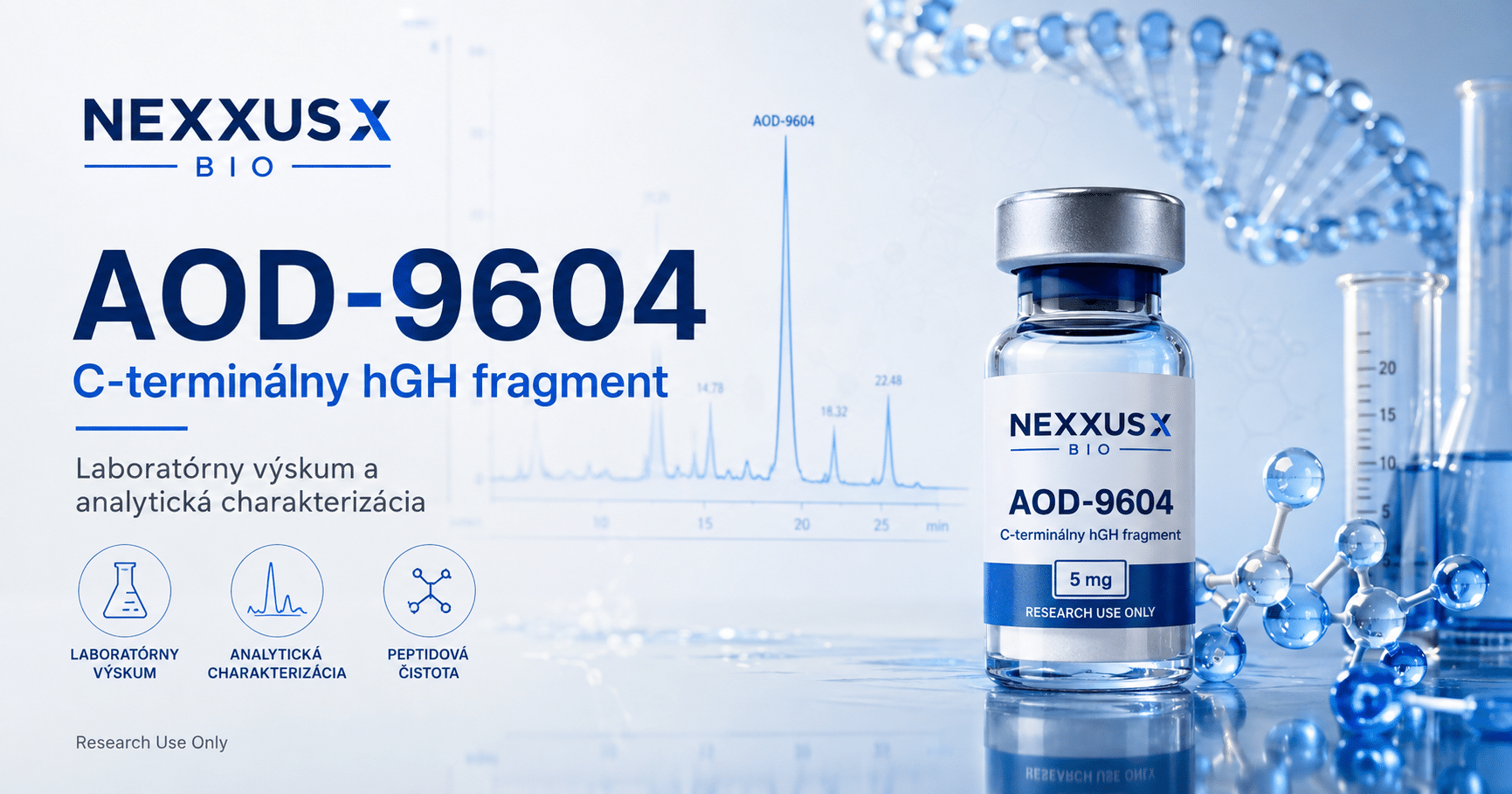
AOD-9604 hGH fragment It is a synthetic peptide derived from the C-terminal region of human growth hormone (hGH). In experimental research, it has been studied primarily in relation to the structural and functional properties of hGH fragments, lipid metabolism, adipocyte signaling, and β-adrenergic mechanisms.
However, when interpreting published results, it is important to distinguish between: Full-fledged human growth hormone, its C-terminal fragments, AOD-9604, and specific research-grade material. These terms do not automatically denote the same molecule or the same level of scientific evidence.
Contents of the article
- What is AOD-9604?
- Structure and nomenclature of AOD-9604
- AOD-9604 versus hGH fragment
- Preclinical research on lipid metabolism
- β3-adrenergic signaling
- Metabolism and analytical detection of AOD-9604
- Level of scientific evidence
- Current regulatory and security context
- Research-grade AOD-9604 and analytical documentation
- What does the available research not show?
- FAQ
- Scientific and regulatory sources
What is AOD-9604?
AOD-9604 is a synthetic peptide derived from the C-terminal portion of human growth hormone. The molecule was developed as an experimental fragment designed to study the biological properties of this region of hGH without using the entire molecule of growth hormone.
The research on AOD-9604 has historically focused primarily on metabolic models, adipocyte signaling, and the relationship between the C-terminal region of hGH and lipid metabolism.
However, this does not mean that the properties of the entire molecule hGH can be automatically attributed to AOD-9604 or vice versa.
Structure and nomenclature of AOD-9604
Different designations may appear in internet catalogs and scientific literature for AOD-9604, therefore the exact nomenclature is important.
An analytical publication dedicated to the detection and metabolism of AOD-9604 describes the molecule as a peptide composed of The C-terminal fragment of hGH corresponding to amino acids 177–191 with an additional tyrosine residue at the N-terminus.
Primary source:
Detection and in vitro metabolism of AOD9604.
The newly added N-terminal residue is one of the reasons why this region may also be referred to as hGH 176–191. When comparing studies, it is therefore necessary to verify the exact molecule and sequence used in a particular experiment.
| Labeling | Research significance | Important restriction |
|---|---|---|
| hGH | Full-fledged human growth hormone. | It is not identical with its short C-terminal fragment. |
| hGH C-terminal fragment | The experimental area of the hGH molecule used in structural-functional studies. | The exact sequence of the fragment must be given. |
| AOD-9604 | Modified C-terminal hGH fragment used in experimental research. | It cannot be automatically confused with any material labeled as „GH Fragment“. |
| Research-grade AOD-9604 | A specific synthetic laboratory batch. | Its identity and quantity must be verified using its own analytical documentation. |
AOD-9604 versus whole growth hormone
Human growth hormone is a substantially larger protein molecule with a wide spectrum of receptor and physiological interactions.
AOD-9604 represents only a short portion of the C-terminal region of this molecule. For this reason, it is not scientifically correct to automatically assume that the short fragment reproduces the complete biological activity of hGH.
The comparison of the entire hGH and its fragments was precisely one of the goals of older experimental studies.
Preclinical research on lipid metabolism
One of the important experimental works was published in 2001 in the journal Endocrinology.
The authors compared human growth hormone and its C-terminal fragment AOD-9604 in obese mice models and genetically modified mice without β3-adrenergic receptors.
In these from animal models They monitored changes in body weight, adipose tissue and the expression of the β3-adrenoreceptor.
Primary source:
Important interpretation:
The results of the metabolic experiment in mice describe the behavior of the molecule in a specific preclinical model. They cannot be automatically translated into a claim of weight reduction, fat reduction, or other personal health effects in humans.
β3-adrenergic signaling
β-adrenergic receptors constitute a group of receptors involved in the cellular response to catecholamine signaling.
In adipocyte and animal models, attention was mainly paid to β3-adrenergic receptor, which is associated in certain experimental systems with the regulation of lipid metabolism.
In the work of Heffernan et al., the expression of the β3-adrenoceptor was monitored and the response of normal experimental animals was compared with a β3-AR knockout model.
This type of experiment helps to investigate whether a specific receptor pathway is necessary for the observed biological response.
| Experimental area | What is being studied |
|---|---|
| Adipocyte biology | Bunk mechanisms of lipid metabolism. |
| β3-AR | The role of β3-adrenergic receptor signaling in the experimental model used. |
| hGH fragments | The relationship between the structure of the C-terminal region of hGH and the biological response. |
| Knockout models | Validation of the role of a specific receptor by removing its function from the model system. |
However, the receptor mechanisms observed in animals or in cell models cannot be automatically interpreted as a clinical result in humans.
Metabolism and analytical detection of AOD-9604
AOD-9604 was also the subject of analytical research aimed at identifying it and determining its metabolism.
In a study published in 2015, scientists developed a method for detecting the molecule and subsequently studied its behavior after incubation in serum and urine.
The authors identified several potential metabolites. One of the fragments was more stable under experimental conditions than the original molecule and the other observed metabolites.
Primary source:
Okano et al. – Detection and in vitro metabolism of AOD9604.
This type of work is useful for analytical chemistry, peptide fragment identification, and the development of mass spectrometry methods. However, it does not provide evidence of clinical efficacy.
Level of scientific evidence for AOD-9604
When reading information about AOD-9604, it is advisable to distinguish between several types of evidence.
| Data type | Example | Correct interpretation |
|---|---|---|
| Structural analysis | C-terminal hGH fragment and its modification. | Information about molecular identity and structure. |
| Bunk models | Adipocyte and receptor signaling. | A mechanistic value from a specific experimental system. |
| Animal models | Obese and β3-AR knockout mice. | Preclinical result, not an automatic result in humans. |
| Analytical experiments | Detection and in vitro metabolism. | Information on identification, stability and metabolites. |
| Research-grade COA | HPLC, MS and quantitative analysis of a specific batch. | Analytical characterization, not evidence of clinical safety or efficacy. |
Current regulatory and security context
With AOD-9604, it is important to separate the historical experimental development from the current regulatory status.
The U.S. FDA lists AOD-9604 among the bulk drug substances for which potential significant safety issues have been identified in the context of compounding.
The FDA primarily points out possible issues related to:
- immunogenicity with certain routes of administration,
- peptide impurities,
- characterization of the active pharmaceutical substance,
- and with a limited amount of available safety information.
Official source:
FDA – Certain Bulk Drug Substances for Use in Compounding that May Present Significant Safety Risks.
This regulatory context is another reason why research-grade material cannot be presented as a clinical or consumer product.
Research-grade AOD-9604 and analytical documentation
Scientific publications describe the molecule used in a specific experimental system. They do not automatically provide information about the quality of a particular commercially available batch.
Therefore, the laboratory evaluation of AOD-9604 is particularly relevant for:
- precise molecular identity,
- verification of the sequence or the corresponding molecular weight,
- chromatographic purity,
- quantitative determination of quantity,
- batch number or lot number,
- the analytical method used,
- the traceability of the COA to a specific sample.
More about the evaluation of purity, documentation, and traceability can be found in the article 7 criteria for selecting a peptide supplier.
The documentation available for the analyzed batches can also be verified in the section COA and analytical documentation.
What does the available research not show?
With AOD-9604, it is necessary to clearly distinguish the results of experimental models from consumer claims.
The available data by themselves do not show:
- that the results observed in mouse models apply automatically to humans,
- that a change in β3-adrenergic signaling means a confirmed clinical result,
- that AOD-9604 is equivalent to a full-fledged human growth hormone,
- that every material labeled as „HGH Fragment 176-191“ is analytically identical to AOD-9604,
- that the research-grade batch is equivalent to the material used in a specific scientific study,
- clinical safety or efficacy of a particular commercial material,
- that high chromatographic purity constitutes evidence of a health effect.
Therefore, it is not appropriate to present AOD-9604 with consumer terms such as „fat burner“, „weight loss peptide“, „fat burner“ or to claim specific results in the field of body weight in humans based on preclinical experiments.
How to critically read studies on AOD-9604?
It is advisable to check at every publication:
- the exact identity and sequence of the examined fragment,
- whether it was AOD-9604, another hGH fragment or the whole hGH,
- whether a cellular, animal or human model was used,
- what was the primary experimental endpoint,
- which receptor pathway was monitored,
- whether it is a biological, analytical or clinical study,
- whether the results were replicated by independent research institutions.
This approach helps to separate structural characteristics, mechanistic preclinical results, and real clinical evidence.
FAQ – AOD-9604 and research
What is AOD-9604?
AOD-9604 is a synthetic peptide derived from the C-terminal part of human growth hormone. Its structural properties, adipocyte biology, β-adrenergic signaling, and molecular metabolism were studied in experimental research.
Is AOD-9604 the same as whole growth hormone?
No. Human growth hormone is a substantially larger protein molecule. AOD-9604 represents only a short synthetic fragment derived from its C-terminal region.
Why is AOD-9604 also referred to in connection with hGH 176–191?
The published analytical work describes AOD-9604 as a fragment of hGH 177–191 with an additional N-terminal tyrosine residue. This leads to the use of designations related to the 176–191 fragment. Therefore, when conducting scientific work, it is necessary to verify the exact sequence.
What did preclinical models show?
Experimental studies in mice examined lipid metabolism and β3-adrenergic signaling. The results of these models cannot be automatically interpreted as an effect in humans.
Are there analytical data on the metabolism of AOD-9604?
Yes. The published work investigated the detection of AOD-9604 and the formation of potential metabolites after incubation of the molecule in serum and urine.
Does HPLC mean a purity above 99% and a % confirmed quality of the entire material?
No. HPLC area purity is only one analytical parameter. Identity, quantity, molecular form, stability, and other properties must be evaluated separately.
Is the chromatographic dominant peak evidence that the peptide is not degraded?
Not by itself. The dominant peak describes the chromatographic profile of the method used. Further analytical data and a properly designed stability study are necessary for reliable evaluation of stability or degradation.
Further professional articles focused on the laboratory and scientific context can be found in the section Research on peptides.
Scientific and regulatory sources
- Heffernan M, Summers RJ, Thorburn A, et al. The effects of human growth hormone and its lipolytic fragment (AOD9604) on lipid metabolism following chronic treatment in obese mice and beta(3)-AR knock-out mice. Endocrinology. 2001. PubMed
- Okano M, Sato M, Ikekita A, Kageyama S. Detection and in vitro metabolism of AOD9604. Drug Testing and Analysis. 2015. PubMed
- Wilding J. AOD-9604 Metabolic. Current Opinion in Investigational Drugs. 2004. PubMed
- U.S. Food and Drug Administration. Certain Bulk Drug Substances for Use in Compounding that May Present Significant Safety Risks. FDA
Important notice:
This article is for informational, educational, and scientific purposes only. The information describes structural, analytical, cellular, and preclinical research data. It is not intended as medical advice, diagnosis, prevention, or a guide to treatment.
Results obtained in cellular or animal models cannot be automatically interpreted as a confirmed result in humans. Similarly, the equivalence between the experimental material used in a scientific publication and another commercially available research-grade batch cannot be assumed.
Research-grade AOD-9604 and other materials presented on the NEXXUS BIO website are intended solely for laboratory, analytical, and scientific purposes (Research Use Only). They are not intended for human or veterinary use, consumption, diagnosis, prevention, or treatment.