


Blog
Peptide purity above 99 %%: what it really means


With research peptides, details matter, not impressions. Peptide purity above 99% % is among the parameters that at first glance seem simple, but in practice they have a direct impact on the interpretation of results, batch comparability, and confidence in the material supplied. If this figure is presented without context, it has only limited explanatory value.
In the research-grade product segment, purity is often used as a quick indicator of quality. However, the number alone is not enough. What also matters is the method used to determine purity, and whether it is supported by evidence. COA documentation, How the batch is labeled and whether the supplier communicates other parameters consistently, such as the form, quantity, packaging, and availability.

What does the purity of peptides above 99 mean? %
Most often it is the analytically determined proportion of the main substance in the given sample. If the purity of the product is stated to be above 99 %%, this means that the dominant portion of the sample consists of the desired peptide, and the proportion of the secondary components is minimal within the framework of the analytical method used. This is important especially where high accuracy is expected in laboratory, analytical or comparative applications.
However, a distinction must be made between a marketing claim and a technical data. In a serious research context, this parameter should be linked to specific documentation. Without it, it is not clear whether it is actually an analyzed value for a given batch or merely a generally declared product standard.
Cleanliness above 99 % therefore does not only mean a „better product“. It mainly means a lower risk that the result will be affected by unidentified impurities, by by-product peptide fragments, or by inconsistent production. For sensitive analytical procedures, this predictability is often more valuable than the marketing emphasis on high quality itself.
Why the purity of peptides above 99 is % not the only parameter
Even very high purity is only one part of the overall picture. A researcher or an informed customer should always check whether other data are clearly stated as well. This includes batch identification, product form, amount of active substance, type of packaging and availability of documentation. If these information are missing, the purity percentage itself loses part of its value.
Consistency between batches is also important. A well-processed series does not mean that the same standard will be applied in the long term. That is why professional suppliers rely on repeatability rather than on a one-time strong claim. For laboratory and analytical purposes, stability of the quality standard is often more crucial than attractive presentation.
It should also be understood that the purity number indicates the proportion of the main component, not automatically all the material properties. It does not describe the storage, handling, transport conditions itself, nor whether the product was properly labeled. Quality in practice arises only through the combination of analytical purity, transparent documentation, and a disciplined process approach.

How cleanliness is verified in practice
In a professional environment, peptide purity is not typically presented as a standalone claim. It should be linked to the analytical output, most commonly within the COA. This document helps confirm that the declared parameter is not just a general description of the catalog item, but data linked to a specific batch.
For an informed recipient, it is essential that the documentation is complete and consistent. If the numbers, batches, or names do not match the product designation, it creates unnecessary room for doubt. With sensitive assortments, the accuracy of administrative details is just as important as laboratory data.
Not every customer needs to analyze the methodological background in depth, but they should be able to assess the basic characteristics of transparency. A serious supplier does not work with vague shortcuts without explanation, with unclear photos of documents, or with general formulations without any connection to the product. The more precise the presentation is, the less room there is for misinterpretation.
COA as the foundation of trust
The Certificate of Analysis is not a formal supplement. In practice, it is one of the main documents by which one can assess whether the purity of a peptide is communicated responsibly. The COA should make sense as a whole – from the identification of the substance to its binding to a specific series.
If a supplier claims purity above 99 %%, but cannot link it to documentation, it is a weaker signal. Conversely, if the COA is available, understandable and corresponds to the product label, it creates a significantly higher standard of transparency.
Why it matters for the batch
In laboratory practice, a batch is more than just an internal number. It allows for retrospective review of documentation, comparison of individual batches, and maintaining order in the analytical process. Without a clear link to the batch, even a very well-sounding parameter of purity becomes more difficult to verify.
It is here that the difference between an unclear offer and a professionally managed catalog becomes apparent. When the form, quantity, packaging, and batch are clearly stated, the customer can make decisions based on facts, not estimates.
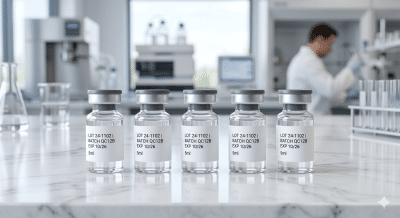
When cleanliness is above 99 the % greatest importance
It has the greatest benefit in situations where reproducibility is crucial. When results are compared between batches, between time points, or between different product items, a lower impurity level reduces the risk of bias. This does not mean that every research scenario automatically requires the same standard, but in precise analysis, high purity is a logical requirement.
The importance increases even when the customer works with a narrowly specialized product range and does not want to waste time searching for missing data. In such a case, cleanliness above 99 is % valuable, especially in conjunction with a clear product card and consistent labeling. The number itself saves little time. A well-structured information framework saves significantly more time.
On the other hand, high purity is not a reason to ignore other qualitative characteristics. If a product is poorly described, packaged in a vague way, or without traceable documentation, even a declared value above 99 % remains incomplete. Quality in this segment must be readable throughout the entire process, not just in one line.
How to read the product offer without unnecessary assumptions
When evaluating the offer, it pays to check that the communication is disciplined. A professional sales representative of research peptides usually provides the exact name of the product, the form, quantity, packaging, stock status, and documentation without unnecessary wording. This style of communication is not cosmetics. It is a practical sign that the supplier understands the need for accuracy.
If information is scattered, inconsistent, or varies between different products without apparent logic, the customer experience deteriorates. For the customer, this means more time, more uncertainty, and a higher risk of making the wrong choice. In the specialized segment, therefore, the structure of the offering is part of quality, not just a question of design.
NEXXUS BIO relies precisely on this transparency – clear labeling, consistent parameters, and an emphasis on documentation help separate technical facts from general claims. For a customer who purchases for research, analytical, or collecting purposes, such an approach is more practical than aggressive advertising communication.
Most common misunderstandings regarding the purity data
One of the common misunderstandings is the idea that purity above 99 % automatically solves all the questions surrounding quality. It does not. It refers to a very important but still partial parameter. If the COA, batch labeling, or precise product specification, The image remains incomplete.
The second misunderstanding lies in the fact that every claim about purity has equal weight. It does not. The difference lies between transparently documented data and loosely used wording without any basis in documentation. In practice, therefore, it is not just a matter of what is written, but also of how exactly it is supported.
The third problem is often the confusion between the quality of the product and the quality of the presentation. A good presentation in itself is not enough, but an unclear presentation is a warning sign. If the supplier cannot clearly communicate the basic technical data, trust in other claims naturally decreases.
When choosing Research-grade peptides Therefore, it pays to look at cleanliness as part of a broader system of control and transparency. A number above 99 % is meaningful when it is readable, verifiable, and consistent across the entire offering. It is precisely there that a serious catalog differs from an unclear sales list.
If decision-making is to be fast and accurate, it is not enough to look for the highest percentage. It is much more useful to look for order in the data, clear documentation, and consistency that will hold up even when looking more closely.

Important notice: The content of this article serves solely for informational, educational and academic purposes. The information provided here is based on available scientific studies and professional literature on research chemical substances. In no case does the text constitute medical recommendations, diagnosis, instructions for treatment, or an invitation to human or veterinary consumption. The products mentioned in the article, as well as the entire range of the NEXXUS BIO e-shop, are classified as research chemicals and laboratory reagents intended strictly for use in a controlled scientific environment (Research Use Only). The website operator assumes no responsibility for the incorrect interpretation of the text or any misuse of the described materials.
Ensuring a high degree of purity of peptides above 99 % is crucial for their use in research and development. Such purity guarantees a minimum amount of contaminants, which is essential for the accuracy of experiments and the reproducibility of results. When working with such materials, it is essential to adhere to strict laboratory procedures and guidelines to avoid potential risks. In accordance with this practice, it is necessary that all experiments be conducted only in professional and controlled conditions.