


Blog
Research-grade peptides: significance in practice


The importance of the term research-grade peptides: What to look for when choosing?
In the case of laboratory material, the details matter, not marketing slogans. In the case of products such as Research-grade peptides, their true significance It does not denote a marketing detail, but a difference between material that can be worked with systematically and material that raises unnecessary questions even before the analysis begins. If a peptide is to be included in a research, analytical, or collection context, it is not enough to know only the name of the substance. What matters is purity, form, documentation, consistency of batches, and the way these data are presented.
In practice, this term is often used too loosely, which is a problem. Not every product labeled as „research“ provides the same standard of information. Therefore, for the informed customer, the essence does not lie in the label itself, but in whether the supplier can accurately indicate what they are selling, in what form, in what quantity, and with what level of verifiable quality.
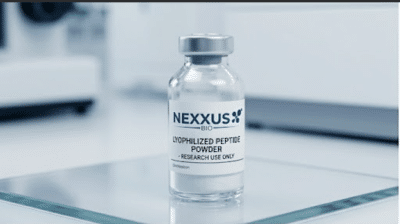
What exactly does the meaning of the term research-grade peptides mean?
When it is said research-grade, We are talking about the qualitative and documentation level of a product intended exclusively for scientific and research use. This is not an assertion about the effect or a universal guarantee of suitability for any type of work. This means that the product is presented within a clearly defined research framework and that its parameters are communicated precisely, not by estimation.
It is also important to clarify what this term fundamentally does not mean:
-
Research-grade does not mean approval for human or veterinary use.
-
It also does not mean that every peptide with this designation is automatically of equal quality.
Without precise purity data, without an available analysis certificate (COA), and without consistent packaging labeling, such a term is empty and has only minimal value for the researcher’s purchasing decision.

Which parameters determine whether a designation makes sense?
It has the greatest weight cleanliness. If the product specifies a purity above 99 %, This is an important reference point, but only if it is backed up by real documentation. The number itself without context doesn’t say much. Therefore, a quality catalog does not just work with a percentage, but also with information about the specific batch, the product form, and the availability of accompanying data.
Equally essential is form. Lyophilized peptide (freeze-dried powder), solution or other laboratory form have different requirements for storage, handling and interpretation within the research. If the supplier does not clearly specify the form, there is room for errors even at the basic orientation stage.
The same applies to quantity in the package. The difference between 5 mg, 10 mg or combined products is not a cosmetic detail, but a key parameter that must be clearly stated.
The third important area is consistency of batches. Research material only makes sense when a comparable standard can be expected between different batches. This does not mean absolute identity without any deviations, but a disciplined quality control system and transparent labeling. Without this, even a visually appealing product becomes untrustworthy.
Why is COA more than just a formal attachment?
The abbreviation peptide is often used in place of peptide. COA (Certificate of Analysis), However, its true significance is sometimes underestimated. For a serious buyer, it is not an insignificant bonus. It is one of the main points that shows whether the supplier’s offer is based on transparency or just baseless promises.
COA helps to connect a specific batch with specific analytical data (e.g., from HPLC or MS analysis). This allows for a qualitative standard for Research-grade peptides It is based on a verifiable foundation. Of course, here too, the mere existence of the document is not enough. What matters is whether it is clearly associated with the product and whether the entire presentation makes sense in the context of the packaging, form, and labeling of the batch.
Warning: If a supplier works with documentation that is unclear or only partially accessible, this is a sign of increased caution. In a segment where decisions are made based on the accuracy of parameters, incomplete documentation is a practical problem, not an administrative minor detail.
The importance of the term research-grade peptides when choosing a supplier
From the customer’s perspective, this label has the greatest value only when combined with the quality of the presentation of the actual offer. If the catalog is cluttered, the products are labeled inconsistently, and basic information must be painstakingly tracked, even a good product loses part of its credibility. In the case of specialized assortments, what is sold is not the only factor determining quality; it is also how exactly it is categorized and described.
Therefore, it is important to monitor whether the products are categorized according to research areas, whether the packaging, form, quantity, and availability are listed for each item, and whether the same standard of information is repeated across the entire range. Trust in such a segment does not arise through general promises. It arises through the orderliness of the data.
NEXXUS BIO It builds precisely on this principle. Not on exaggerated claims, but on a clear presentation of qualitative parameters, documentation, and strict research determination. For a customer who does not want to be overwhelmed by a vague offer, this is a practical advantage.

Where do the most common misunderstandings arise?
-
The idea of universal superiority: One of the most common misunderstandings is the confusion of this concept with the pretended „magical“ category that solves everything on its own. In reality, it is a legislative framework for determination and a level of transparency. It only matters when it is backed by precise data.
-
Comparison only based on price: A low price may seem attractive, but if there is no clear labeling of quantity, form, or documentation, the comparison is not fair. A product with complete information and consistent batch control cannot be mechanically compared with an item where half of the data is missing.
-
Ignoring the regulatory framework: With research peptides, the separation of research use from human or veterinary use must be clear. If a seller communicates inaccurately or intentionally misrepresents the designation of products, it reduces their credibility.
How to read the product card without making assumptions
A good product card should be readable without the need for interpretation between lines. The basis is the exact name of the peptide, the form, quantity, packaging, and availability. Next comes information about purity and documentation. If these elements are arranged logically, the customer can make decisions quickly and without unnecessary questions.
However, if the card works with vague concepts or does not separate essential parameters from marketing phrases, the user experience slows down. In the professional segment, this is a weakness. The buyer does not need persuasion; they need precise data. The less assumptions are necessary, the higher the functional value of the offer.
This also applies to supplementary laboratory materials. Components such as bacteriostatic water or acetic acid They must be equally clearly classified and described as peptides in themselves. If the main range is processed in detail, but the auxiliary material appears sloppy, the overall standard falls.
Why is consistency across the entire range important?
A single product may look good, but the true picture of the supplier is given by the entire catalog. If one peptide has clear parameters, the other has incomplete labeling, and the third has unclear packaging, this is a sign of an inconsistent system. For a customer who purchases repeatedly or compares multiple items, this is a significant disadvantage.
Conversely, a consistent catalog saves time and reduces errors when selecting information. When the same types of information are in the same place across the entire portfolio, navigation is quick and confidence grows naturally.
An overview of the most frequently analyzed research-grade peptides:
| Type of peptide | Main research area | Standard of purity and form |
| BPC-157 | Research on tissue regeneration and the gastrointestinal tract | Above 99 % (Lyophilized powder) |
| GHK-Cu | Analysis of cellular regeneration and collagen stimulation | Certified premium quality |
| TB500 | Study of muscle healing, tendons, and cellular migration | Exclusively for laboratory purposes |
| AOD9604 | Research on lipid metabolism and obesity models | Precise batch consistency |
| Epithalon | Analysis of telomere length and cellular aging | High degree of laboratory purity |
Note: Other compounds such as Retatrutide, Melanotan II and PT141 also require the same discipline in the data structure.
It is precisely here that it is revealed the full meaning of the term research-grade peptides. Not as an isolated label, but as a set of disciplines in quality, documentation, labeling, and categorization. When these elements work together, the product is placed in the research context in a clear and noise-free way.
When choosing in this segment, it pays to trust less to big words and to pay more attention to small, concrete details. Cleanliness, COA, batch, form, quantity, and clear research determination say more about a product than any advertising slogan.
This article is provided for educational and informational purposes only. All users must seek the necessary professional guidance before handling peptides.