


Blog
Epithalon peptide: telomeres, telomerase and cellular research

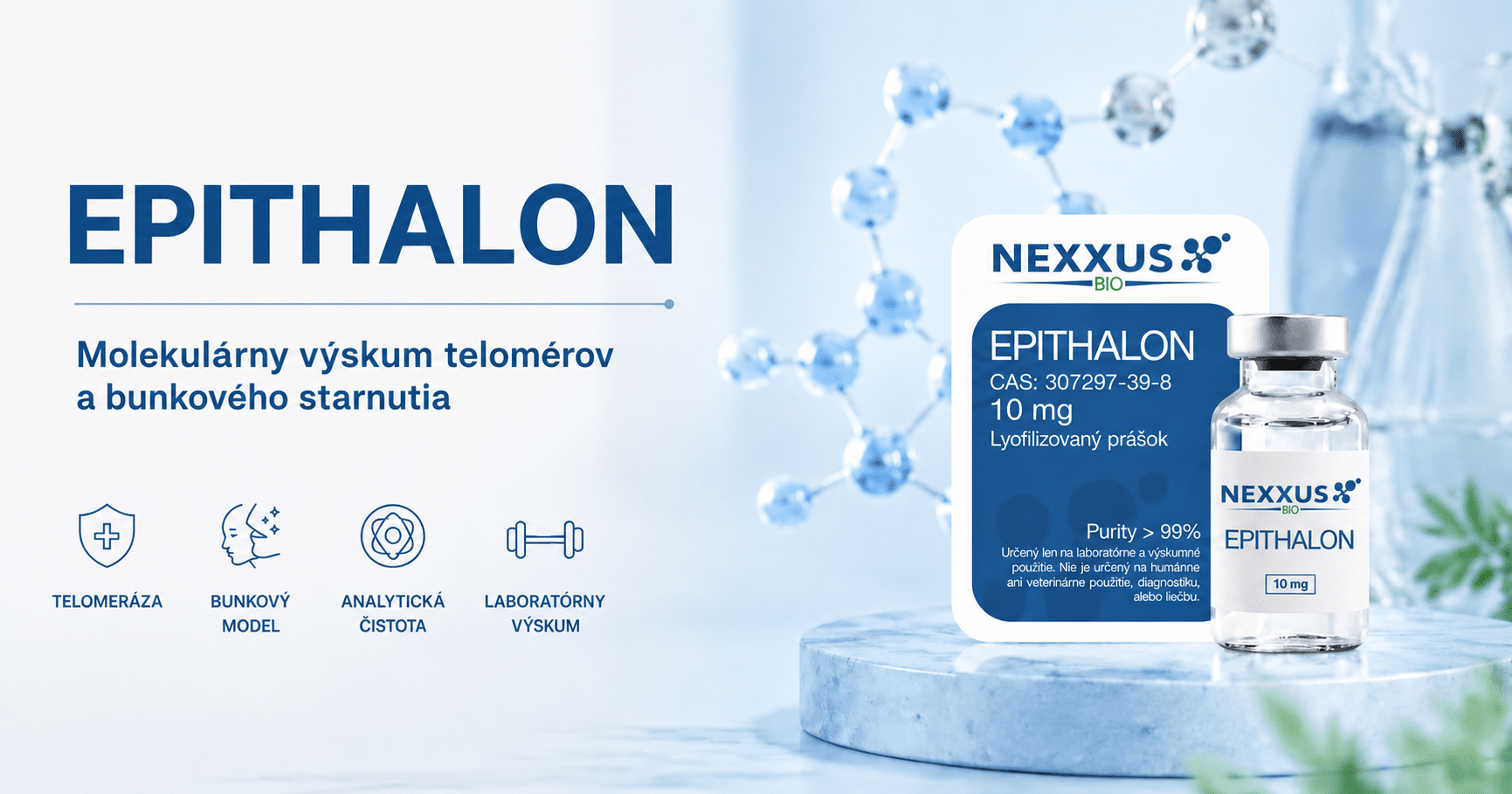
Epithalon peptide, also known as Epitalon or AEDG, is a synthetic tetrapeptide with the sequence Ala-Glu-Asp-Gly. In scientific research, it is mainly studied in connection with telomeres, telomerase, cellular signaling, gene regulation, and other mechanisms of cellular biology.
However, when interpreting published results, it is important to distinguish between: Epitalon/Epithalon as synthetic tetrapeptides, preparation Epithalamin containing a complex of peptides from epiphyse and specific research-grade material. The results obtained for one of these forms cannot be automatically attributed to the others.
Contents of the article
- What is Epithalon?
- Epithalon versus Epithalamin
- What are telomeres?
- Epithalon and telomerase in cell models
- More recent data from 2025
- ALT and tumor cell lines
- Nuclear localization and DNA
- Gene expression and cell models
- Level of scientific evidence
- Research-grade Epithalon and analytics
- What does the research not show?
- FAQ
- Primary scientific sources
What is Epithalon?
Epitalon, often written as Epithalon, is a synthetic tetrapeptide composed of four amino acids:
Both names – Epitalon and Epithalon – appear in the professional literature. Therefore, when searching for scientific publications, it is advisable to use both variants together with the designation AEDG.
Experimental research on this molecule involves cell models, animal models, molecular experiments, and studies focused on telomerase signaling.
Current scientific overview of chemical identity and experimental research:
Overview of Epitalon – Highly Bioactive Pineal Tetrapeptide.
Epithalon versus Epithalamin
There is a common nomenclature error when it comes to this topic.
Epithalon/Epitalon refers to the defined synthetic tetrapeptide AEDG. Epithalamin on the contrary, it refers to a more complex peptide preparation derived from epiphysis.
| Labeling | Characteristics | Important when interpreting |
|---|---|---|
| Epitalon / Epithalon | Synthetic tetrapeptide Ala-Glu-Asp-Gly (AEDG). | The results should be linked to studies that actually used AEDG. |
| Epithalamin | A complex peptide derived from the epiphyse. | Older data on Epithalamine cannot be automatically presented as data on Epitalone. |
| Research-grade Epithalon | A specific synthetic laboratory sample or batch. | It must be evaluated based on its own identity, purity, quantity, and COA. |
This resolution is important especially for older literature, because some studies on human participants examined Epithalamin, not the pure synthetic tetrapeptide AEDG.
What are telomeres?
Telomeres They are specialized nucleoprotein structures at the ends of chromosomes. Their function is to help protect the ends of linear DNA and contribute to maintaining chromosomal stability.
In many somatic cells, during repeated division, there are gradual changes in telomere length. However, telomere biology is more complex than the simple rule „longer telomeres = longer lifespan“.
Important note:
Telomere length is only one of many parameters of cellular biology. Extending the telomere length in a cell culture in itself does not indicate a slowdown in the biological aging of the organism, an extension of healthy life, or a clinical benefit in humans.
Epithalon and telomerase in cell models
One of the most frequently cited studies on Epitalon was published in 2003. The researchers examined telomerase-negative human fetal fibroblasts in cell culture.
After exposure to Epitalon, the authors observed in this model the expression of the catalytic subunit of telomerase, telomerase enzymatic activity, and a change in telomere length.
Primary source:
But this is about in vitro experiment with human cells. The results of cell culture cannot be interpreted as evidence of prolonging life or slowing down human aging.
More recent data from 2025
In 2025, another study was published that re-examined the relationship between Epitalon and telomerase biology in several human cell lines.
The research included normal fibroblast and epithelial cells, but also selected tumor cell lines.
In normal cell models, scientists observed changes in telomere length along with an increase in hTERT mRNA and telomerase enzymatic activity.
Primary source:
A formal correction was subsequently issued with the publication:
Correction – Biogerontology, 2025.
Even this more recent work remains cellular study. It does not represent clinical evidence of the effectiveness of Epitalon in humans.
ALT mechanism and tumor cell lines
The newer study is also interesting because it did not only track telomerases.
In the studied tumor cell lines, the authors also observed the activity of a mechanism known as Alternative lengthening of telomeres (ALT).
ALT represents a telomerase-independent mechanism of telomere maintenance that occurs in certain cellular and tumor systems.
This result also shows why it is not appropriate to automatically label telomerase or telomere activity as „beneficial“. The biology of telomeres differs significantly between normal and transformed cells.
| Mechanism | Research significance |
|---|---|
| hTERT | The catalytic subunit of telomerase studied in the regulation of telomerase activity. |
| Telomerase | An enzyme complex involved in telomeric DNA. |
| ALT | An alternative mechanism for maintaining telomere length independent of classical telomerase. |
| Body length | One of the measurable parameters of telomere biology, not a separate indicator of the overall biological state of the organism. |
Nuclear localization and interactions with DNA
Further mechanistic work investigated the ability of short peptides to penetrate into the cell and the cell nucleus.
Fluorescence was observed in the cytoplasm, nucleus, and cell nucleus of HeLa cells in experiments with fluorescenced Epitalon.
The authors also investigated the interactions of short peptides with DNA and deoxyribonucleotides. in vitro.
Primary source:
Fedoreyeva et al. – Penetration of short fluorescence-labeled peptides into the nucleus.
The older mechanistic work also proposed a model of possible binding of regulatory peptides to certain DNA sequences. However, this is an experimental and model hypothesis, not evidence of a universal mechanism in the human organism.
The DNA double helix binds regulatory peptides similarly to transcription factors.
Gene expression and cell models
The research on Epitalon is not limited to telomeres alone.
A 2020 publication examined AEDG in human gingival mesenchymal stem cells during experimentally induced neurogenic differentiation.
In the cell-based system used, the authors observed changes in mRNA and protein markers associated with differentiation, and using molecular modeling they investigated possible interactions of the peptide with histones.
Primary source:
AEDG Peptide (Epitalon) Stimulates Gene Expression and Protein Synthesis During Neurogenesis.
These results describe the behavior of a specific cell culture and cannot be automatically interpreted as a neurological or clinical effect.
Other experimental cell models
In 2025, a study using a cell model of human retinal pigment epithelial cells in conditions of increased glucose concentration was also published.
The researchers monitored cell migration, oxidative parameters, gene expression, and markers associated with experimental damage to the cell layer.
Primary source:
Gatta et al. – Epitalon in an in vitro model of diabetic retinopathy.
Even despite the medically sounding title of the publication, it is about in vitro cell model, Not about the study of treating patients.
Level of scientific evidence
| Data type | Example | Correct interpretation |
|---|---|---|
| In vitro human cells | hTERT, telomerase, telomeres, gene expression | Mechanistic data from a controlled cellular system. |
| Animal models | Various physiological and experimental models | Preclinical observation that cannot be automatically transferred to humans. |
| Older human works | Part of publications about pineal peptides | It is necessary to verify whether Epitalon or the Epithalamin complex was used. |
| COA / analytical documentation | Identity, chromatographic purity and quantity of a specific batch | It does not demonstrate clinical safety, efficacy, or effects on aging. |
Research-grade Epithalon and analytical documentation
The results of the published study describe specific experimental material and conditions. In themselves, they do not confirm the quality of another commercially available batch.
Therefore, in the case of laboratory Epithalone, it is advisable to evaluate it separately:
- the identity of the tetrapeptide,
- the Ala-Glu-Asp-Gly sequence,
- molecular weight,
- chromatographic purity,
- quantitative determination of quantity,
- batch number or lot number,
- the analytical method used,
- the COA bond to the specific analyzed batch.
More about the evaluation of analytical documentation can be found in the article 7 criteria for selecting a peptide supplier.
The documents available for the individual analyzed batches can also be found in the section COA and analytical documentation.
What does the available research not show?
Regarding Epithalon and telomeres, it is particularly important to avoid simplifying experimental data.
The available results in themselves do not prove anything:
- that prolongation of telomeres in cell culture means prolongation of human life,
- that the increase in telomerase activity is a universally beneficial biological phenomenon,
- that experimental results on cells automatically apply to the entire organism,
- that the results of Epithalamin can be automatically attributed to synthetic Epitalon,
- that the results of one molecular form apply to every research-grade batch,
- clinical safety or efficacy of a particular commercial material,
- the slowing of biological aging, rejuvenation, or prolongation of a person's healthy life.
Therefore, it is not appropriate to label Epithalon with consumer terms such as „anti-aging peptide“, „elongation peptide“, „anti-aging peptide“ or to claim that it „prolongs life“. Such formulations go beyond the level of evidence available from cellular and preclinical studies.
How to critically read studies on Epithalone?
It is advisable to check at every publication:
- whether Epitalon/Epithalon or Epithalamin was studied,
- whether it was a cellular, animal or human model,
- whether telomerase, hTERT, telomere length, or any other parameter was measured,
- whether the result was obtained in normal or tumorous cells,
- what was the primary experimental endpoint,
- whether it is a primary study or an overview article,
- whether the observations were replicated by an independent research group.
FAQ – Epithalon, telomeres and research
What is Epithalon?
Epithalon, also known as Epitalon, is a synthetic tetrapeptide with the sequence Ala-Glu-Asp-Gly (AEDG). It is studied in scientific research in cellular and preclinical models, including telomere biology.
Is Epithalon the same as Epithalamin?
No. Epitalon is a synthetic tetrapeptide AEDG, while Epithalamin is a more complex peptide preparation derived from the epiphysis. The results of these materials cannot be automatically confused.
Did Epitalon affect telomerase in laboratory experiments?
Yes. Published cell studies have recorded changes in hTERT expression, telomerase activity, and telomere parameters after exposure to Epitalon. However, these are laboratory cell results, not clinical evidence in humans.
Do longer telomeres mean a longer lifespan?
No. Telomere biology is complex, and the length of the telomere itself is not evidence of longer or healthier life. Results from cell cultures cannot be extrapolated in this way.
What is hTERT?
hTERT is a catalytic subunit of human telomerase. It is one of the parameters used in research on the regulation of telomerase activity.
What does ALT mean?
ALT stands for Alternative Lengthening of Telomeres. This is an alternative mechanism for maintaining telomeres that is independent of the classical telomerase pathway and can occur in certain cellular systems.
Is a purity claim for research-grade Epithalone enough?
No. Chromatographic purity is only one parameter. Identity, molecular weight, material quantity, batch number and analytical documentation must be evaluated separately.
You can find more professional articles in the section Research on peptides.
Primary scientific sources
- Khavinson VK, Bondarev IE, Butyugov AA. Epithalon peptide induces telomerase activity and telomere elongation in human somatic cells. Bull Exp Biol Med. 2003. PubMed
- Al-Dulaimi S, Thomas R, Matta S, Roberts T. Epitalon increases telomere length in human cell lines through telomerase upregulation or ALT activity. Biogerontology. 2025. PubMed
- Al-Dulaimi S, Thomas R, Matta S, Roberts T. Correction: Epitalon increases telomere length in human cell lines through telomerase upregulation or ALT activity. Biogerontology. 2025. PubMed
- Fedoreyeva LI, Kireev II, Khavinson VK, Vanyushin BF. Penetration of short fluorescently labeled peptides into the nucleus in HeLa cells and in vitro specific interaction of the peptides with deoxyribonucleotides and DNA. Biochemistry. 2011. PubMed
- Khavinson V, Diomede F, Mironova E, et al. AEDG Peptide (Epitalon) Stimulates Gene Expression and Protein Synthesis during Neurogenesis: Possible Epigenetic Mechanism. Molecules. 2020. PubMed
- Gatta M, Dovizio M, Milillo C, et al. The antioxidant tetrapeptide Epitalon enhances delayed wound healing in an in vitro model of diabetic retinopathy. Stem Cell Rev Rep. 2025. PubMed
Important notice:
This article is for informational, educational, and scientific purposes only. The information describes molecular, cellular, and preclinical research data and does not constitute medical advice, diagnosis, prevention, or treatment instructions.
Changes in telomerase activity or telomere length observed in cell models cannot be automatically interpreted as a slowing of aging, rejuvenation, prolongation of life, or a confirmed health effect in humans.
Research-grade Epithalon and other materials presented on the NEXXUS BIO website are intended solely for laboratory, analytical, and scientific purposes (Research Use Only). They are not intended for human or veterinary use, consumption, diagnosis, prevention, or treatment.