


Blog
MOTS-c peptide: AMPK and mitonuclear signaling in research

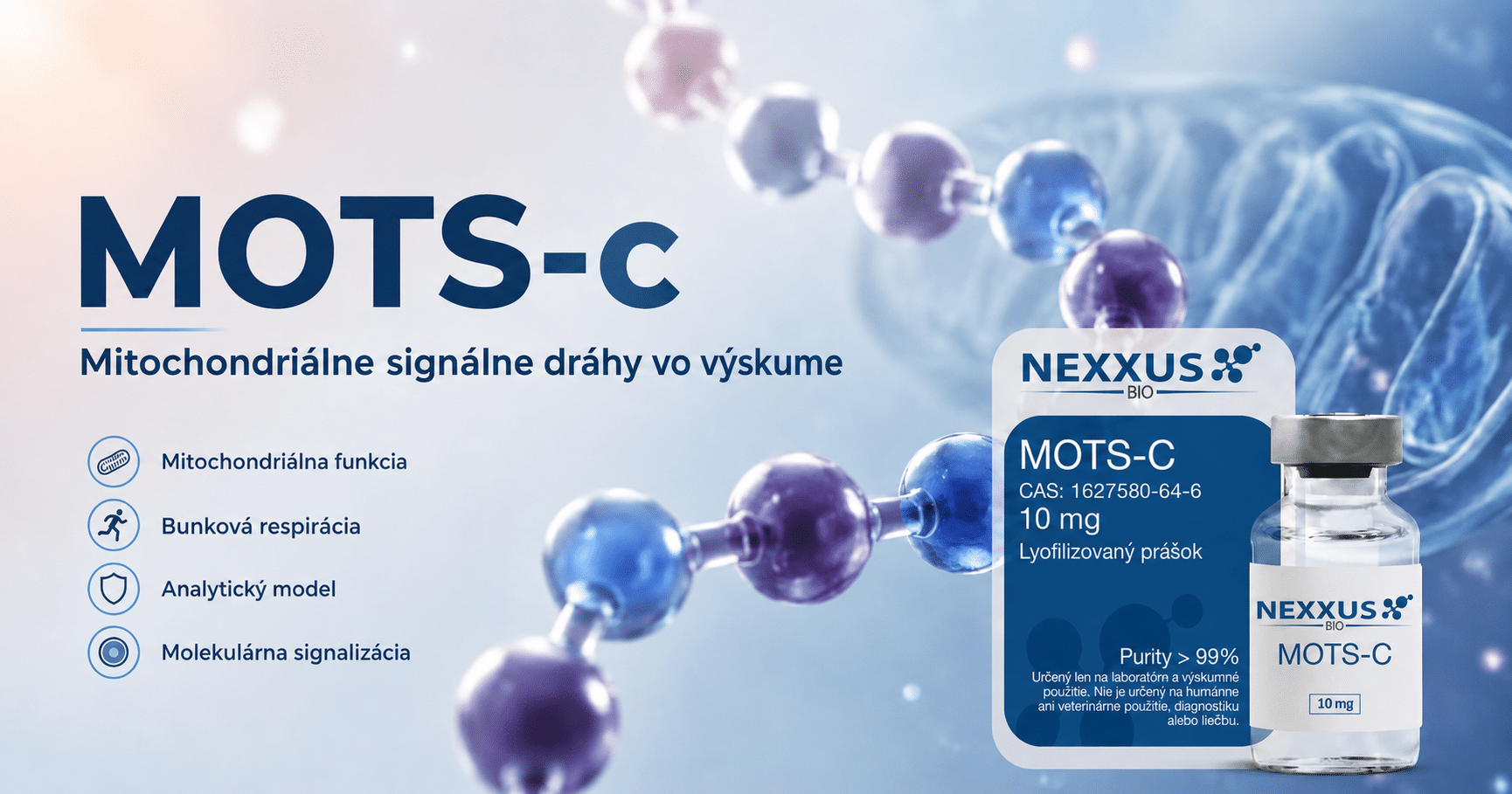
MOTS-c mitochondrial peptide The 16-amino acid molecule is associated with a short open reading frame in the mitochondrial 12S rRNA region. Since its first description in 2015, it has been the subject of research focused on mitochondrial signaling, cellular response to metabolic stress, AMPK, and communication between the mitochondrial and nuclear genomes.
When interpreting the available data, it is important to distinguish between: endogenous MOTS-c observed in biological systems, A synthetic molecule used in experimental models and specific research-grade material. The results of cellular or animal experiments cannot be automatically transferred to humans or other laboratory samples.
Contents of the article
- What is MOTS-c?
- Basic characteristics of MOTS-c
- The folate cycle, purine biosynthesis and AMPK
- MOTS-c nuclear translocation
- Mitonuclear communication
- MOTS-c and skeletal musculature
- Preclinical metabolic models
- The level of human research
- Level of scientific evidence
- Regulatory context
- Research-grade MOTS-c and analytical documentation
- What does the available research not show?
- FAQ
- Primary scientific sources
What is MOTS-c?
Name MOTS-c comes from the designation mitochondrial open reading frame of the 12S rRNA type-c. The molecule was described as a short peptide product associated with the mitochondrial genome region.
The published sequence contains 16 amino acids:
The discovery of MOTS-c has broadened the view of mitochondria as organelles that, in addition to their classical role in cellular metabolism, can also produce signaling molecules. This group is referred to as mitochondrial-derived peptides (MDP).
The basic work was published in 2015 in the journal Cell Metabolism:
The title of the original publication includes the results observed in specific experimental models. These data must be interpreted according to the study methodology and not as a general health claim.
Basic characteristics of MOTS-c
| Parameter | Research characteristics |
|---|---|
| Name | MOTS-c |
| Length | 16 amino acids |
| Sequence | MRWQEMGYIFYPRKLR |
| Genetic context | The mitochondrial 12S rRNA region |
| Research class | Mitochondrial-derived peptide (MDP) |
| Mechanisms studied | AMPK, purine biosynthesis, nuclear translocation, and the stress gene response |
| Level of evidence | First of all, cellular and animal models; interventionary human research is underway |
The folate cycle, purine biosynthesis and AMPK
One of the most important mechanistic findings of the original work was the connection between MOTS-c and folate cycle and de novo purine biosynthesis.
In the used experimental systems, scientists observed changes in metabolites related to these pathways, including AICAR, which is associated with activation. AMP-activated protein kinase (AMPK).
AMPK is a cellular kinase involved in regulating the cellular energy response. Therefore, AMPK has become one of the main mechanistic points for further research of this mitochondrial-derived molecule.
| Research path | What is being studied |
|---|---|
| The folate cycle | Changes in metabolic intermediates in experimental models. |
| Purine biosynthesis | Relationship to de novo synthesis of purines and the metabolite AICAR. |
| AMPK | Cell signaling associated with energy status and metabolic stress. |
The change in AMPK signaling is a mechanistic finding. In itself, it does not constitute confirmation of a specific clinical or health outcome.
MOTS-c nuclear translocation
In 2018, a significant mechanistic work was published examining the subcellular localization of this molecule during metabolic stress.
In cell models, the following was observed: MOTS-c translocation into the cell nucleus for example, in glucose restriction, serum deprivation and oxidative stress.
The authors also monitored changes in the expression of genes related to the stress response and interactions with transcriptional mechanisms associated with antioxidant response elements (AREs).
Primary source:
Mitonuclear communication
The functioning of a cell requires the coordination of the nuclear and mitochondrial genomes. Most mitochondrial proteins are encoded by nuclear DNA, but mitochondria also produce signals capable of influencing the nuclear response.
MOTS-c represents one of the experimental models of the so-called retrograde mitochondrial signaling.
From a scientific perspective, therefore, it is not just a question of one metabolic pathway. The research touches on a broader mechanism:
This very concept is among the most interesting areas of current mechanistic research on MOTS-c.
MOTS-c and skeletal muscle: what did the research show?
The work published in 2021 combined cellular, animal, and human experimental data.
In animal models, scientists investigated gene expression, metabolic mechanisms in skeletal muscle, and the response to experimental conditions in different age groups of mice.
The human part had a different character. The researchers monitored Endogenous MOTS-c after physical exertion In healthy volunteers, changes in its expression in skeletal muscle and circulation were observed.
Primary source:
Important distinction:
Observing the change in endogenous MOTS-c after physical exercise in humans is not evidence that exogenous synthetic material replicates the effects of physical activity. The results from animal experiments with the administered molecule and human observations of endogenous MOTS-c must be interpreted separately.
Preclinical metabolic models
The first studies using MOTS-c primarily used cellular and animal models of metabolic homeostasis. It is from these that much of the knowledge about AMPK, skeletal muscle, and metabolic response comes from.
In further studies, the research was extended to other experimental systems as well.
Pancreatic islets and cellular senescence
In 2025, a study focused on pancreatic islets and cellular senescence was published. The research included isolated islets and animal models.
The authors also provided observational human data comparing circulating levels of endogenous MOTS-c between the study groups.
Primary source:
The experimental administration of the molecule in a preclinical model and the observational measurement of its endogenous levels in humans represent two different types of evidence.
Mitochondrial respiration in cardiac tissue
A 2025 study examined mitochondrial bioenergetics in the heart tissue of a model of metabolic dysfunction.
The researchers used high-resolution respirometry and other laboratory techniques to assess oxidative phosphorylation, ATP production, oxygen consumption, and reactive oxygen species.
Primary source:
This is a preclinical animal model and an analysis of isolated tissue. Therefore, the results cannot be presented as a confirmed cardiovascular effect in humans.
What is the level of human research in 2026?
Much of the research to date is still preclinical. Human data include, for example, observational measurements of the endogenous molecule and its changes under certain physiological conditions.
However, in 2026, an intervention study is also being conducted in the ClinicalTrials.gov registry. MOTS-MET (NCT07505745).
This is a randomized, double-blind, placebo-controlled Phase 2 study. According to the current registry, the planned number is approximately 120 participants, and it is being conducted as of August 2026. Recruiting. The results have not yet been published.
Current record:
ClinicalTrials.gov – MOTS-MET, NCT07505745.
Registration of a clinical study means that a certain scientific hypothesis is systematically tested. However, in itself, it does not confirm the efficacy, safety, or regulatory approval of the substance being studied.
Level of scientific evidence for MOTS-c
| Data type | Example | Correct interpretation |
|---|---|---|
| In vitro | AMPK, the stress response, nuclear translocation | Mechanistic data from a specific cellular system |
| Animal models | Muscle, pancreatic and cardiac experimental models | Preclinical results that cannot be automatically transferred to humans |
| Human observational data | Endogenous levels or expression in the studied groups | Association or physiological observation, not evidence of the effect of exogenous material |
| Interventional clinical research | MOTS-MET | Phase 2 is underway; results are not yet available |
| COA / analytical analysis | Identity, chromatographic purity and quantity of a specific batch | It does not constitute evidence of clinical safety or efficacy |
Regulatory context in 2026
In July 2026, American FDA Pharmacy Compounding Advisory Committee MOTS-c free base and MOTS-c acetate were discussed among the substances under consideration for possible inclusion in the so-called 503A Bulks List.
This process concerns the rules for pharmaceutical compounding in the USA and It is not identical to the regulatory approval of the drug.
The FDA also explains that advisory committees provide the agency with expert recommendations that are non-binding.
Official source:
FDA – Pharmacy Compounding Advisory Committee, July 2026.
Research-grade MOTS-c and analytical documentation
The results of scientific publications cannot be automatically used as evidence of the quality of a particular commercially available batch. Research-grade material must be evaluated based on its own analytical documentation.
In laboratory evaluation, the following are particularly relevant:
- the exact sequence and identity of the molecule,
- molecular weight,
- chromatographic purity,
- quantitative determination of quantity,
- batch number or lot number,
- the analytical method used,
- the traceability of the COA to a specific sample.
More about the evaluation of purity, documentation, and traceability of research-grade materials can be found in the article 7 criteria for selecting a peptide supplier.
The documentation for the analyzed batches can also be verified in the section COA and analytical documentation.
What does the available research not show?
When interpreting scientific articles about MOTS-c, it is necessary to clearly separate the experimental observations from broader claims.
The available data by themselves do not show:
- that the synthetic molecule reproduces the effects of physical activity in humans,
- that the results obtained in mice or rats apply automatically to humans,
- that the change in AMPK signaling represents a confirmed health benefit,
- that the difference in endogenous levels of MOTS-c is the cause of a specific disease,
- that the research-grade batch is identical to the investigative material used in the clinical study,
- the clinical safety or efficacy of a specific research-grade product.
Therefore, it is not appropriate to label MOTS-c with general consumer terms such as „fitness peptide“, „fat burner“, „energy booster“ or „anti-aging peptide“. Such formulations go beyond the level of evidence available from individual experimental models.
How to critically read MOTS-c studies?
When publishing any publication, it is important to check:
- whether endogenous or synthetic MOTS-c was tested,
- whether it was a cellular, animal or human model,
- whether the human study only measured the endogenous molecule or investigated the investigational material,
- what was the primary experimental endpoint,
- whether it is a primary study or an overview article,
- whether the results were independently reproduced by other workplaces as well.
This approach helps to distinguish between the mechanistic hypothesis, preclinical results, human observations, and clinical evidence.
FAQ – MOTS-c and scientific research
What is MOTS-c?
MOTS-c is a 16-amino acid mitochondrial-derived peptide linked to a short open reading frame in the mitochondrial 12S rRNA region. It is studied in connection with cellular signaling, metabolic stress, and mitonuclear communication.
What mechanisms are being investigated in MOTS-c?
The most commonly studied mechanisms include the folate cycle, de novo purine biosynthesis, AICAR/AMPK signaling, translocation into the cell nucleus, and the stress-induced gene response.
Does MOTS-c pass into the cell nucleus?
In cell models, translocation of MOTS-c into the nucleus and changes in the expression of selected genes were observed during metabolic stress. These are mechanistic experimental data.
Is MOTS-c related to physical activity?
A published study recorded changes in endogenous MOTS-c in skeletal muscle and circulation in healthy volunteers after physical exercise. However, this observation does not show that synthetic exogenous material is equivalent to physical activity.
Is there any intervention clinical research in humans?
Yes. A phase 2 MOTS-MET study is being conducted in the ClinicalTrials.gov registry. Recruitment is ongoing and results have not yet been published as of August 2026.
Does the ongoing clinical study mean regulatory approval?
No. Registration or the conduct of clinical research constitute a process of testing a scientific hypothesis, and not a regulatory approval of the substance being studied.
Is an HPLC purity data sufficient for research-grade material?
No. Chromatographic purity is only one analytical parameter. Identity, molecular weight, quantity of material, batch number, and other analytical data must be evaluated separately.
Further professional articles focused on the laboratory and scientific context can be found in the section Research on peptides.
Primary scientific and regulatory sources
- Lee C, Zeng J, Drew BG, et al. The mitochondrial-derived peptide MOTS-c promotes metabolic homeostasis and reduces obesity and insulin resistance. Cell Metabolism. 2015. PubMed
- Kim KH, Son JM, Benayoun BA, Lee C. The mitochondrial-encoded peptide MOTS-c translocates to the nucleus to regulate nuclear gene expression in response to metabolic stress. Cell Metabolism. 2018. PubMed
- Reynolds JC, Lai RW, Woodhead JST, et al. MOTS-c is an exercise-induced mitochondrial-encoded regulator of age-dependent physical decline and muscle homeostasis. Nature Communications. 2021. PubMed
- Kong BS, Lee H, L’Yi S, et al. The mitochondrial-encoded peptide MOTS-c prevents pancreatic islet cell senescence to delay diabetes. Experimental & Molecular Medicine. 2025. PubMed
- Pham T, Taberner A, Hickey A, Han JC. Mitochondria-derived peptide MOTS-c restores mitochondrial respiration in type 2 diabetic heart. Frontiers in Physiology. 2025. PubMed
- ClinicalTrials.gov. MOTS-c for Improving Insulin Sensitivity in Adults With Prediabetes and Overweight/Obesity – MOTS-MET, NCT07505745. ClinicalTrials.gov
- U.S. Food and Drug Administration. July 23–24, 2026 Meeting of the Pharmacy Compounding Advisory Committee. FDA
Important notice:
This article is for informational, educational and scientific purposes only. The information describes molecular, cellular, preclinical, observational, and ongoing clinical research data. It is not intended as medical advice, diagnosis, prevention, or a guide to treatment.
Results obtained in cell cultures or animal models cannot be automatically interpreted as a confirmed clinical effect in humans. The observations of endogenous MOTS-c in humans also do not indicate efficacy or safety of exogenous synthetic material.
Research-grade MOTS-c and other materials presented on the NEXXUS BIO website are intended solely for laboratory, analytical, and scientific purposes (Research Use Only). They are not intended for human or veterinary use, consumption, diagnosis, prevention, or treatment.